The
Long Fist system & Chaquan history
The
Long Fist system & Chaquan history
Our Northern Long Fist System consists of:
Fundamental training:
-Jibengong (基本工); fundamental exercises including various stretching and kicking techniques
-Wu bu quan (五步拳); 5 stances training form
Hand forms :
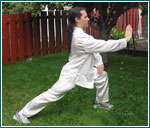
The hand forms develop structure, root, coordination, footwork, speed, agility and power. Our Long fist system include the following styles:
-Tan tui (彈腿)
-Chaquan (查拳)
-Shaolinquan (少林拳)
2 persons forms:
The two-person forms teaches the combat applications of the movements which includes various punching, kicking, grabbing, sweeping and throwing techinques as well as various blocking and evading techniques. Those forms are essential to learn the figthing aspect of traditional Northern Long Fist Kung fu.
Weapons:
A variety of traditional weapons are taught within the system, including:
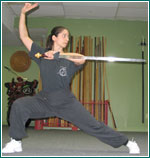
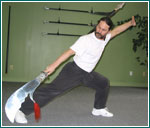
-Staff, Spear, Broadsword, straight sword, Da Dao (cleaver), Double hooked swords, Single Fan, Double Fan, Double Broadsword, Double Daggers and Three-section staff.
Conditioning:
Students regularly train on equipments such as the heavy bag and focus pads to develop power and fluiditiy.
Free fighting:
The practice of fighting applications in a non-compliance context and eventually free-fighting (sparring) is an important part of traditional Kung fu training. Students practice their techniques in such a way on a regular basis.
Qi gong:
Internal development is essential to maintain health, treat injuries and develop internal power. A variety of breathing exercises are taught for various purposes.

Chaquan (pronounced Cha chuan) is a very
popular style of northern Kung fu. However, its history can not be verified and many different versions can be found. Here's the most popular version.
During the Tang Dynasty (618-907),
a crusade went on an expedition to east China. When the army reached
the Shandong province (then named "Guanxian" county),
a general named Hua Zongqi was wounded so he had to stay behind
to recover. He was taken care of by the local residents. To thank
them, general Hua taught them his style of kung fu which was called
Jiazi quan. He ended up having many students and eventually had
to invite his kung fu brother Zha Yuanyi to help him teach. Zha
and Hua stayed together and became esteemed martial arts teachers.
Zha's Jiazi quan was slightly more compact than Hua's, therefore Zha's version was called Xiaojia quan (small frame fist) and Hua's version was called Dajia quan (big frame fist). After Zha Yuanyi and Hua Zongqi died, their followers named the two styles of Jiazi Quan after their tutors. The style taught by Zha Yuanyi was called Zha quan (Chaquan) and Hua Zongqi's style was named Hua quan.
Later on, the Zha-style and the Hua-style were known as one style. Those who were good at Zha-style were also good at Hua-style. Subsequently, this style of fist fight became known as the Zha-Hua quan.
The Hua-style has four routines. Three of them are long programs with varied tricks and moves, which are considered the cream of jiazi Quan.
The Cha-style has 10 routines. During the Qing Dynasty
(1736-1795), the Zha-style divided into three branches in Shandong
Province. The Zhang-style, represented by Zhang Qiwei from Village
Zhangyin at Guanxian, is fast, agile and compact. The Yang-style,
represented by Yang Hongxiu from the southern part of the town
of Guanxian, is upright, comfortable and graceful. The Li style,
represented by Li Enju from Jining, is powerful, and continuous.
Top of page